통합 검색
통합 검색
LengtheningㅣCorrection
Gangnam Champion Orthopedic Surgery
Hospital
- Limb Lengthening & Correction
- Spine & Joint
- Hand & Foot
- Rehabilitation
Brachydactyly Type D
Clubbed Thumb Surgery
in Korea
Surgical Correction for
Clubbed Thumbs,
Stub Thumbs &
Short Wide Thumbs
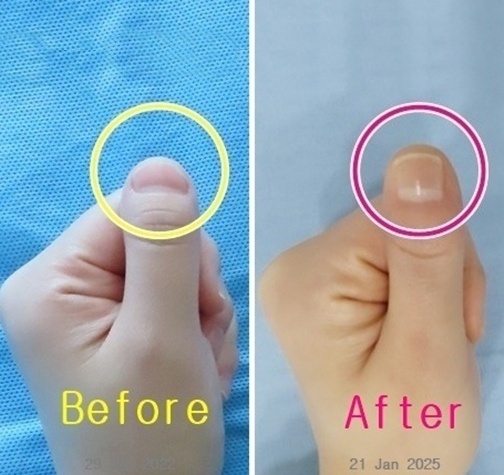
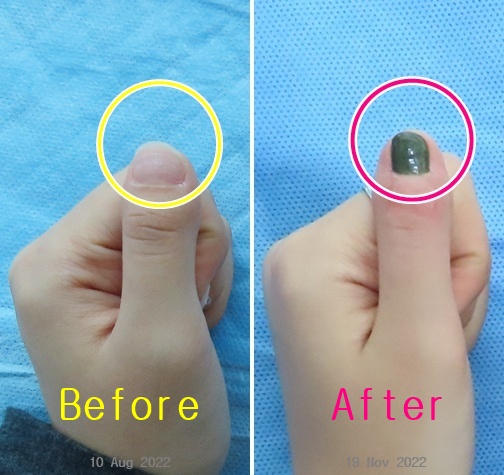
1. What Is Brachydactyly Type D?
Brachydactyly Type D (BDD) is a congenital condition in which the end bone (distal phalanx) of the thumb is shorter and wider than usual.
It is commonly described as a clubbed thumb, stub thumb, stubby thumb, short thumb, or short wide thumb.
The characteristic appearance may include:
✔ A shorter and wider thumb tip
✔ A broad or wide thumbnail
✔ A shortened distal phalanx
✔ A rounded or broad thumb contour
✔ One or both thumbs being affected
Brachydactyly Type D is different from other forms of brachydactyly involving shortened metacarpal, metatarsal, finger, or toe bones.
For this reason, the surgical approach for a clubbed thumb is different from conventional bone-lengthening surgery for short fingers or toes.
2. Common Features of Clubbed Thumbs
Patients with Brachydactyly Type D may notice:
Appearance
✔ Short and broad thumb tip
✔ Wide or broad thumbnail
✔ Shorter thumbnail compared with its width
✔ Rounded or bulky appearance of the thumb
✔ Difference in size or shape between the two thumbs
✔ One thumb may be more affected than the other
Functional Symptoms
Many people with Brachydactyly Type D have relatively normal thumb function.
However, the degree of shortening and shape varies between individuals, and some patients may have concerns related to thumb movement or function.
Cosmetic Concerns
For many patients, the primary concern is the appearance of the thumb.
Some may feel self-conscious when:
✔ Taking photographs of their hands
✔ Wearing rings or accessories
✔ Using nail polish or nail art
✔ Showing their hands in social situations
✔ Comparing the shape of their thumbs with other fingers
Treatment should therefore be considered individually according to anatomy, function, expectations, and personal concerns.
3. What Causes Brachydactyly Type D?
Brachydactyly Type D is generally a congenital skeletal variation.
The distal phalanx, which is the bone underneath the thumbnail, develops shorter and broader than usual.
The nail and surrounding soft tissue develop according to this underlying bone structure, which produces the characteristic short and wide appearance.
BDD may:
✔ Affect only one thumb
✔ Affect both thumbs
✔ Differ in severity between the right and left sides
✔ Occur in other members of the same family
An X-ray can help evaluate the shape and dimensions of the distal phalanx and surrounding structures.
4. How Is Brachydactyly Type D Different from Other Brachydactyly?
This distinction is important.
Typical short-finger or short-toe brachydactyly may involve a shortened:
✔ Metacarpal
✔ Metatarsal
✔ Phalanx
When additional length is required, treatment may therefore involve bone lengthening, bone grafting, or gradual lengthening with an external fixator.
Brachydactyly Type D is different.
The main characteristic is usually a short and broad distal phalanx of the thumb with a broad nail and thumb tip.
Therefore, patients seeking correction of the shape of a clubbed thumb do not necessarily require the same lengthening procedures used for other types of brachydactyly.
Do You Have a Short Finger or Short Toe?
If the main problem is a shortened finger or toe rather than a short, wide thumb, treatment may involve bone lengthening using gradual distraction or bone grafting.
Learn More About Brachydactyly & Brachymetatarsia Surgery
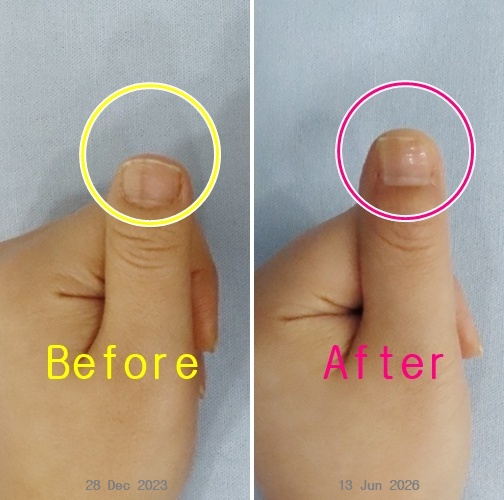
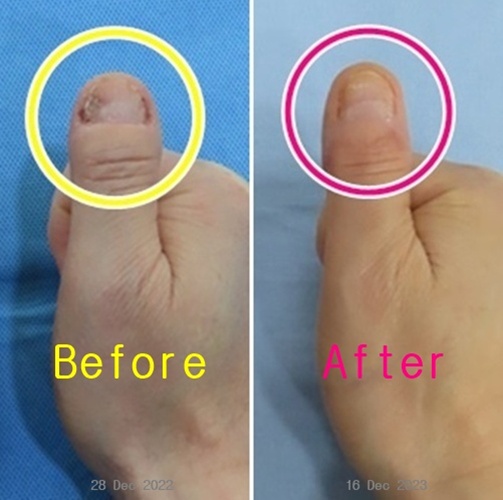
5. Brachydactyly Type D Surgery
Clubbed Thumb Contouring Surgery
Surgical treatment is individually planned according to the width and length of the thumb, nail shape, underlying bone structure, soft-tissue volume, and desired degree of correction.
At Gangnam Champion Hospital, correction may be planned in stages to address different components of the thumb shape.
Depending on the individual anatomy, treatment may involve:
✔ Nail contour correction
✔ Bone contour correction
✔ Reduction of excessive thumb width
✔ Soft-tissue contouring
The goal is to improve the overall proportion and contour of the thumb while preserving function as much as possible.
Because every thumb has different bone, nail, and soft-tissue proportions, the surgical plan must be individualized.
6. Two-Stage Surgical Approach
For selected patients, treatment may be divided into two stages.
This allows the bone/nail structure and soft-tissue contour to be addressed separately.
Stage 1 — Nail & Bone Contouring
The first procedure focuses primarily on the structural width of the distal thumb.
Depending on the patient's anatomy, the procedure may include correction of the:
✔ Nail shape
✔ Nail length/width
✔ Distal phalanx contour
✔ Overall width of the thumb tip
The objective is to create a narrower and more proportionate thumb contour.
Typical Procedure
✔ Regional anesthesia may be combined with sedation as appropriate
✔ No external fixator is required for this contouring approach
✔ Pelvic bone grafting is not generally required
✔ Procedure time is approximately 25 minutes per thumb, although this may vary
✔ Hospitalization may not be necessary in selected patients
The exact surgical method and treatment time depend on individual anatomy.
Stage 2 — Soft-Tissue Contouring
After the thumb has healed from the first procedure, additional soft-tissue contouring may be considered if further narrowing or refinement is desired.
This is generally considered after approximately 3 months or later, depending on healing.
The second procedure may involve removal or reshaping of excessive soft tissue to further refine the contour of the thumb.
Typical Procedure
✔ Approximately 10 minutes per thumb, depending on the extent of correction
✔ May be performed without hospitalization in selected patients
✔ Can be scheduled after adequate healing from the first procedure
The second-stage procedure is not necessarily required for every patient.
The need for additional contouring should be determined after evaluating the result of the first procedure and the patient's individual goals.
7. Why Are Two Procedures Sometimes Recommended?
The appearance of a clubbed thumb is determined by several structures:
Bone + Nail + Skin + Soft Tissue
Attempting to correct every component aggressively during a single operation may not be appropriate for every patient.
A staged approach allows the surgeon to evaluate healing and thumb contour after the structural correction before deciding whether additional soft-tissue refinement would be beneficial.
The appropriate number of procedures depends on the individual patient.
8. Anesthesia
Surgery may be performed using regional anesthesia, such as a brachial plexus block, with sedation when appropriate.
A brachial plexus block temporarily reduces sensation and movement in the operated arm.
The exact anesthetic technique is selected after medical evaluation and discussion with the patient.
9. Before Surgery
Before treatment, the surgeon evaluates:
✔ Thumb length and width
✔ Nail width and shape
✔ Distal phalanx anatomy
✔ Soft-tissue thickness
✔ Joint movement
✔ Right-to-left asymmetry
✔ X-rays when appropriate
✔ Desired degree of correction
Photographs may also be useful for initial evaluation, particularly for international patients.
However, the final surgical plan is determined after an appropriate medical examination.
10. Recovery & Post-Operative Care
Recovery instructions vary according to the exact surgical procedure.
Patients may be instructed to:
✔ Keep the surgical site clean and protected
✔ Perform wound care as instructed
✔ Use a waterproof covering when necessary
✔ Avoid unnecessary water exposure during early wound healing
✔ Begin appropriate thumb movement according to the surgeon's instructions
✔ Attend follow-up examinations or obtain local wound care when returning overseas
In many cases, sutures are removed approximately 3 weeks after surgery, depending on wound healing.
Normal daily activities can be gradually resumed according to pain, swelling, wound condition, and the surgeon's instructions.
11. Rehabilitation
Rehabilitation is generally focused on maintaining thumb mobility.
When medically appropriate, exercises may include:
✔ Thumb flexion
✔ Thumb extension
✔ Opposition exercises
✔ Gentle range-of-motion exercises
✔ Stretching
In selected patients, range-of-motion exercises may begin early after surgery.
The timing and intensity of rehabilitation should follow the surgeon's instructions.
12. Healing Timeline
Healing varies between individuals and according to the extent of surgery.
As a general reference:
✔ Initial wound healing: approximately 3 weeks
✔ Nail regrowth and maturation: approximately 5–6 months or longer
✔ Scar maturation: continues gradually over several months
Swelling and contour may also continue to change during the healing period.
The final appearance should therefore not be judged immediately after surgery.
13. Will the Thumbnail Become Narrower?
Because Brachydactyly Type D often involves both a broad distal phalanx and a broad nail, nail contour may be an important component of surgical planning.
The amount of change that can be achieved depends on:
✔ Original nail width
✔ Nail bed anatomy
✔ Distal phalanx width
✔ Skin and soft-tissue condition
✔ Desired correction
The goal is not to promise a specific nail shape but to improve proportion where anatomically and medically appropriate.
14. Will the Thumb Become Longer?
Clubbed thumb contour surgery and conventional finger-lengthening surgery are different procedures.
The primary purpose of this procedure is generally to improve the width, proportion, and contour of the thumb rather than to substantially lengthen it.
Patients whose main concern is thumb length require an individual assessment to determine whether a different surgical approach would be appropriate.
15. Will There Be a Scar?
Any surgical procedure involving an incision can leave a scar.
Depending on the surgical method, the scar may be approximately 2 cm, but its exact length and location vary according to individual anatomy and the extent of correction.
Scars usually change and mature over time but may not disappear completely.
Scar appearance also varies significantly between individuals.
Appropriate wound and scar care may be recommended after surgery.
16. Possible Risks and Complications
As with any surgical procedure, complications are possible.
Potential risks may include:
✔ Infection
✔ Temporary numbness
✔ Swelling
✔ Temporary limitation of range of motion
✔ Nail irregularity or nail deformity
✔ Scar formation
✔ Asymmetry
✔ Delayed wound healing
✔ Residual width or contour irregularity
✔ Need for additional correction
The likelihood and severity of complications vary according to the patient's anatomy, surgical technique, and healing response.
Potential benefits and risks should be discussed with the surgeon before treatment.
17. What Results Can Be Expected?
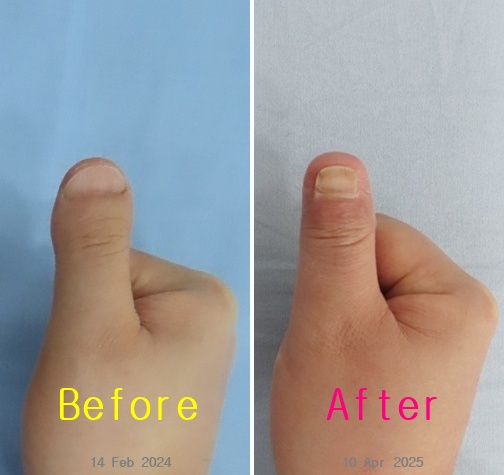
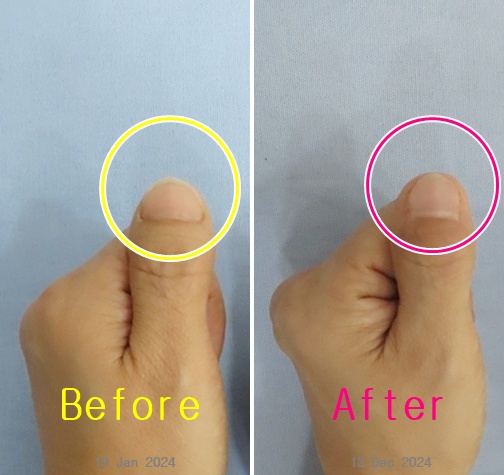
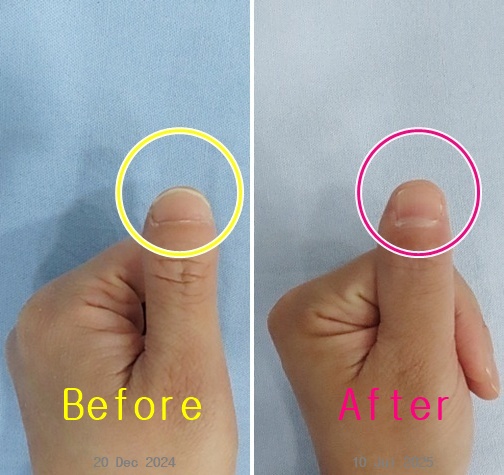
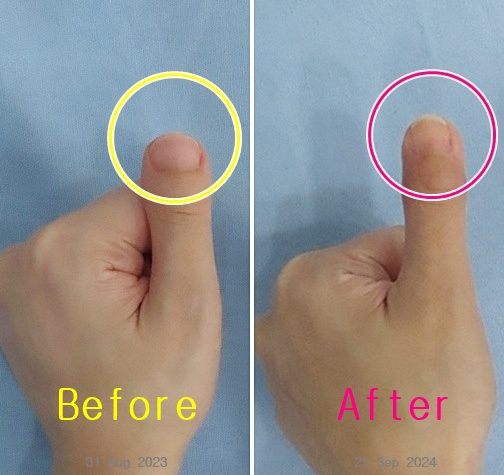
The goal of surgery is to improve the proportion and contour of the affected thumb.
Depending on the patient's anatomy, correction may help create:
✔ A narrower thumb contour
✔ Improved nail-to-thumb proportion
✔ A less bulky thumb-tip appearance
✔ Better visual balance between the thumb and other fingers
However, a surgically corrected thumb cannot be guaranteed to look identical to a naturally shaped thumb.
Results are individual, and complete symmetry or a particular cosmetic result cannot be guaranteed.
Realistic expectations are an important part of treatment planning.
For additional information about the surgical process, postoperative care, healing timeline, and treatment for international patients, please visit our detailed Brachydactyly Type D information page.
18. Frequently Asked Questions
Q. Is Brachydactyly Type D dangerous?
Brachydactyly Type D itself is generally a congenital anatomical variation rather than a dangerous condition. Many people have normal hand function and do not require treatment.
Surgery is generally considered when an individual has significant cosmetic or functional concerns and wishes to explore correction.
Q. Is surgery medically necessary?
Not necessarily. If there are no significant functional problems and the appearance does not cause concern, treatment may not be required.
Surgical correction is an elective option that should be considered after discussing the potential benefits, limitations, scars, and risks.
Q. Do I need an external fixator?
For the contouring procedure described on this page, an external bone-lengthening fixator is generally not required. However, treatment varies according to anatomy and the objective of surgery.
Q. Is a pelvic bone graft required?
Pelvic bone grafting is generally not part of the contouring procedure described here. This differs from certain one-stage bone-lengthening procedures used for other forms of brachydactyly.
Q. Do I need to stay in the hospital?
Selected patients may undergo consultation, examination, surgery, and discharge on the same day. Whether same-day discharge is appropriate depends on the patient's health, anesthesia, surgical procedure, and postoperative condition. International patients should confirm their individual schedule with the hospital before arranging travel.
Q. Can both thumbs be treated on the same day?
Both thumbs may be treated during the same surgical session in selected patients. Whether this is appropriate is determined after evaluation of the patient's anatomy, medical condition, and surgical plan.
Q. When can I use my hands?
Light daily activities may be resumed according to pain, wound condition, and the surgeon's instructions. Activities that place significant pressure or stress on the surgical area may need to be restricted during early healing.
Q. When can I shower?
The surgical area should be protected from water during the initial wound-healing period according to postoperative instructions. A waterproof dressing or covering may be used when appropriate. Normal water exposure is generally allowed after adequate wound healing and according to the surgeon's instructions.
Q. Is the result permanent?
Surgery changes the underlying anatomical structures, so the correction is intended to be long-lasting. However, healing, scar formation, nail growth, aging, and individual tissue response can influence the final appearance. No specific cosmetic result can be guaranteed.
19. Brachydactyly Type D Surgery in Seoul, South Korea
Gangnam Champion Hospital provides evaluation and surgical treatment for patients with Brachydactyly Type D, clubbed thumbs, stub thumbs, and short wide thumbs.
Each patient is individually evaluated based on:
✔ Bone structure
✔ Nail shape
✔ Thumb width and length
✔ Soft-tissue volume
✔ Joint function
✔ Degree of asymmetry
✔ Desired correction
For international patients, an initial assessment may be possible before traveling to Korea.
Patients may send clear photographs and available X-rays for preliminary review.
Final diagnosis and surgical planning require appropriate medical evaluation.
International Patient Consultation
International patients interested in Brachydactyly Type D surgery or clubbed thumb correction in Korea may contact us before making travel arrangements.
When contacting us, it may be helpful to provide:
✔ Clear photographs of both thumbs
✔ Front and side views
✔ Age
✔ Previous hand surgery history, if any
✔ Available X-rays
✔ Preferred travel dates
After preliminary review, information regarding consultation, treatment scheduling, expected stay in Korea, and postoperative follow-up can be discussed.
Gangnam Champion Hospital
525 Ogeum-ro, Songpa-gu
Seoul, South Korea
T : +82-2-408-7575
E : drahn818@naver.com
◆: [ Consultation ]
Patients from overseas may contact the hospital for information regarding consultation, treatment scheduling, expected stay in Korea, and follow-up care.
This page provides general medical information and does not replace an individual medical consultation. Surgical indications, techniques, recovery, risks, and results vary according to each patient's anatomy and medical condition.
-축소 150.jpg)